
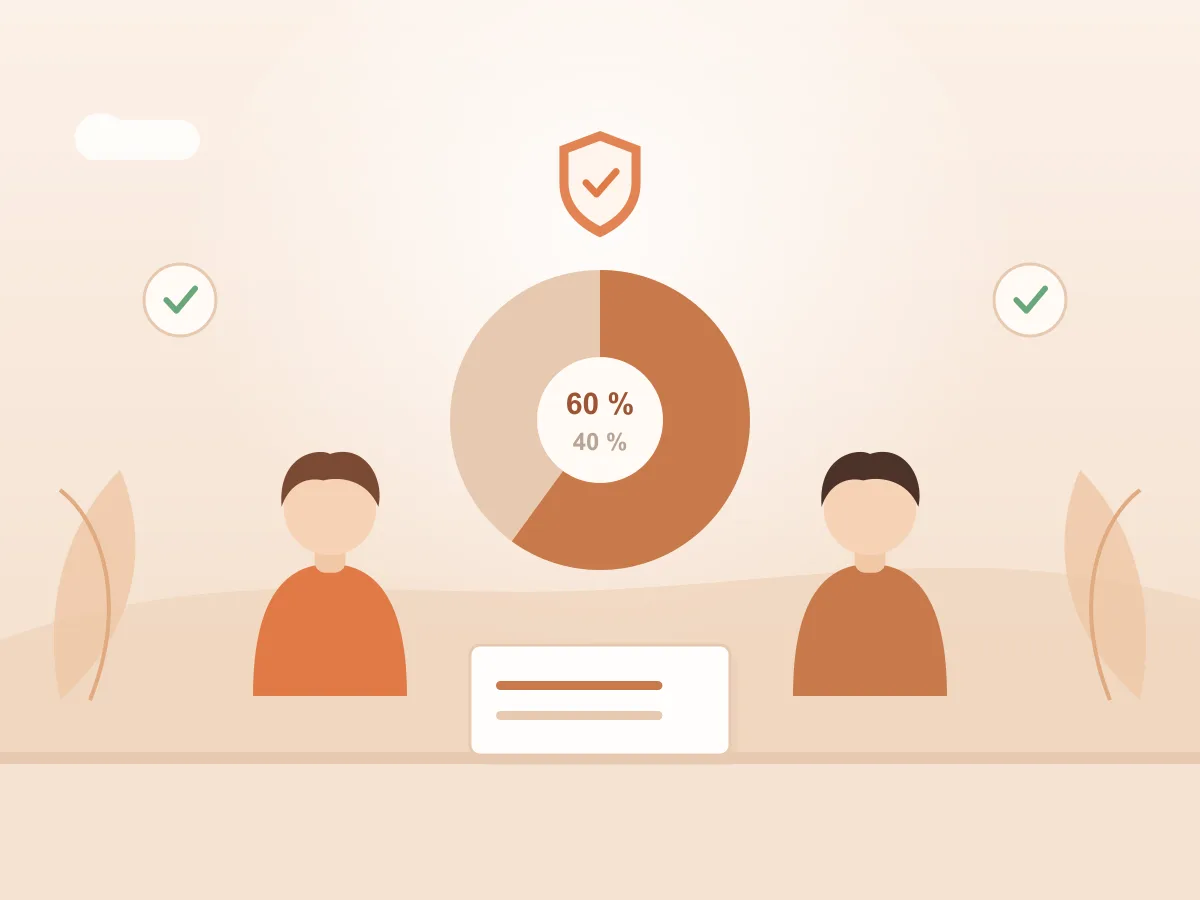
The quotité, or insured share, is the portion of the borrowed capital covered by each borrower's insurance. On your own, you are insured at 100%. For two borrowers, the total must reach at least 100% and can go up to 200%, depending on what the bank requires: 50/50, 100/100 or a split in proportion to income. The right choice depends on what the surviving partner, or the partner still working, could repay alone.
What is the insured share (quotité) in borrower insurance?
The insured share sets the portion of the loan the insurer takes over if the insured person dies, loses their independence or can no longer work. An insured share of 60% means the insurer repays 60% of the outstanding capital in the event of death, or pays 60% of the instalments during a covered period off work, within the limits set by the policy. The rest remains payable by the household.
The rules: 100% minimum, between 100% and 200% for two
- A single borrower: insured share of 100%, the whole loan must be covered.
- Two co-borrowers: the total must be at least 100%, without exceeding 200%. The bank sets the minimum it requires.
- Each insured person has their own share: it can differ from one person to the other, and each can be insured with a different insurer.
50/50, 100/100 or in proportion to income
- 50/50 (total 100%): the cheapest option. But if one of the two dies, the survivor repays half of the loan alone.
- 100/100 (total 200%): each borrower covers the whole loan. If one dies, the loan is repaid in full, at twice the cost.
- In proportion to income: each share reflects each person's contribution to household income. With €3,000 and €2,000 net a month, the first brings in 60% of the income (3,000 / 5,000) and the second 40%: insured shares of 60% and 40%.
- Intermediate options: 100/50, 100/60 or 70/70, for example, to better protect the lower-earning partner without paying for 100/100.
What it costs: a worked example
The cost of insurance is proportional to the insured share. For illustration, take this couple earning €3,000 and €2,000, who borrow €300,000 over 25 years (300 months). Assume each is insured at 0.12% of the initial capital. An insured share of 100% then costs 300,000 × 0.12% / 12 = €30 a month.
- 50/50: €15 + €15 = €30 a month, i.e. €9,000 over the life of the loan.
- 60/40: €18 + €12 = €30 a month, i.e. €9,000. Same cost, different split of the protection.
- 100/50: €30 + €15 = €45 a month, i.e. €13,500.
- 100/100: €30 + €30 = €60 a month, i.e. €18,000.
The actual price depends on each person's age, health, occupation and smoking: if the two rates differ, the split of the same 100% total changes the cost slightly. To reduce the bill without lowering the insured share, the better route is to change policy.
What happens in the event of death or time off work
Keeping the same example, with a loan at 3.5% over 25 years: the monthly instalment, excluding insurance, is about €1,502.
- Death of the borrower insured at 60%: the insurer repays 60% of the outstanding capital. The survivor keeps paying 40% of the instalments, i.e. about €601 a month on an income of €2,000. With 50/50, they would pay about €751; with 100/100, nothing.
- Time off work for the borrower insured at 60%: after the waiting period, often 90 days, the insurer pays 60% of the instalment if the policy is lump-sum. With an indemnity-based policy, the payout is limited to the loss of income actually recorded. During the waiting period, the household pays the full instalment.
The question to ask yourself: if one of you dies or stops working, can the other take on their share of the instalments alone?
Unmarried couples, PACS partners and SCI partners
Co-borrowers are generally jointly and severally liable for the loan: the bank can claim all the instalments from the survivor, whatever the couple's status. Yet without marriage, including for partners in a PACS (the French civil partnership), the surviving partner does not necessarily inherit the deceased's share of the home, depending on the arrangements made (will, terms of purchase). An insured share at least equal to each person's share of the property, or even 100/100, spares the survivor from repaying the share of a home that does not pass to them. A notary can complete these arrangements.
For a loan taken out by an SCI (a French property-holding company), the insured persons are the individual partners, and the insured share is divided between them, often according to their shareholdings or their income, within the limits of what the bank requires. See our guide to borrower insurance for buy-to-let investment.
Insured share and the health questionnaire
The health questionnaire is removed if the insured share does not exceed €200,000 per person, all mortgages combined, and the loan ends before the insured person's 60th birthday. The insured share matters: on €300,000, a 60/40 split gives €180,000 and €120,000 insured, below the threshold (with no other insured mortgage and if the loan ends before each person turns 60); with 100/100, each is insured for €300,000 and the insurer may ask for a questionnaire.
Changing the insured share during the loan
After a separation or a change in income, the split may no longer suit you. Changing the insured share requires the bank's agreement, as it checks that the total remains at least equal to its requirement, and an amendment. An increase in the insured share raises the insured capital: the insurer may then ask for a new health questionnaire. Changing insurer, at signing or during the loan (see insurance delegation), is also an opportunity to review the split, again subject to the bank's agreement.
What the firm does
We analyse the household's income and outgoings, your bank's FSI (the standardised information sheet listing the cover it requires) and the level of protection sought, then we put several insurers in competition with at least equivalent cover for each split considered. We handle the formalities with the bank. The review is free and without obligation.
- The insured share is the portion of the loan covered by each insured person: 100% alone, between 100% and 200% in total for two.
- The cost is proportional to the insured share: 100/100 costs twice as much as 50/50.
- A split in proportion to income (60/40 for €3,000 and €2,000) costs the same as 50/50 at equal rates.
- Reason in terms of what the survivor could repay alone, especially outside marriage.
- Changing the insured share during the loan requires the bank's agreement and may require a new questionnaire.